
 Mike Puddicombe
 Every church leader wants to see change take root, with health restored, mission renewed, and people engaged once again. Yet revitalization rarely fails because of a lack of ideas. More often, it fails because something far more foundational is missing.
The issue is not vision, strategy, or even leadership skill. The real issue is a lack of the right kind of currency.
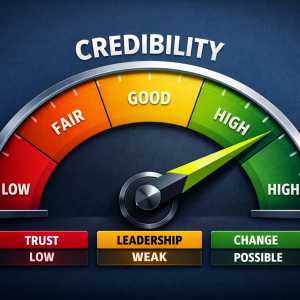
And in church revitalization, that hidden currency is credibility.
Why Change Stalls
Many leaders step into a church assuming that if they cast a compelling vision, people will follow. It sounds reasonable, but it does not reflect how change actually works in a congregational system.
People are not primarily evaluating your ideas. They are evaluating you.
They are asking questions, often quietly and over time. Can I trust you? Do you understand us? Are you for us, or are you trying to change us?
Until those questions are answered, even the strongest vision will struggle to gain traction. In the economy of leadership, vision is only as strong as the credibility behind it.
Four Sources of Credibility
Credibility is not built in a moment. It accumulates over time, and in revitalization work, four sources matter most.
1. Positional Credibility: Access Without Influence
Your role gives you a platform. Because of your title, people will listen at first, and you will have access to important conversations and decisions.
But access is not the same as influence. Positional credibility may open the door, but it will not carry you through the resistance that comes with change. If this is all you have, your leadership will feel increasingly ineffective.
2. Experiential Credibility: Respect Without Movement
Competence matters, and people notice how you lead. They watch how you make decisions, how you communicate, and how you handle complexity.
Over time, this builds respect. However, respect alone does not lead to movement. People may agree with you intellectually and still resist you in practice. Revitalization is not just a cognitive shift. It is emotional and spiritual, and that requires more than competence.
3. Relational Credibility: Trust That Unlocks Movement
This is where real traction begins.
Relational credibility is built when people experience that you see them, value them, listen to them, and walk with them. It develops in ordinary moments, such as hallway conversations, sitting with someone in crisis, remembering names and stories, and showing up when it matters most.
At this point, something begins to shift. People stop asking whether you can lead and start believing that you care about them. As that belief grows, trust begins to outweigh resistance.
For many churches, this is the turning point.
4. Spiritual Credibility: Authority That Must Be Discerned
There is a deeper layer of credibility that cannot be manufactured.
Spiritual credibility grows out of a life that is genuinely rooted in God. It is not something you claim. It is something others discern over time. People begin to notice a depth in your prayers, a weight in your words, and a consistency between your life and your message.
They sense that your leadership is shaped by obedience rather than preference.
When this happens, your influence carries a different kind of authority. However, it must be handled with care. If spiritual language is used too early or to push an agenda, it will often be received as manipulation. In most cases, relational trust must come first.
The Leadership Reality
Every revitalization leader faces a difficult tension. Congregations do not always resist change because they are stubborn. More often, they resist because they do not yet trust the person leading the change.
Until credibility is established, resistance is not a problem to fix. It is a signal to interpret. It is simply saying, “We are not there yet.”
Building the Right Currency
If credibility is the currency of revitalization, then leadership becomes less about pushing change and more about building trust.
This requires slowing down when necessary, being present in key moments, demonstrating consistency over time, and allowing people to experience your leadership before asking for their alignment.
This is not passive leadership. It is strategic patience. Every interaction either strengthens or weakens your credibility.
Final Thought
Before you introduce the next initiative, sermon series, or structural change, ask a more fundamental question.
Do I have enough credibility to carry this?
Vision does not create movement. Trust does. Strategy does not sustain change. Credibility does.
Without the right currency, even the right direction will not move people forward.