
 Mike Puddicombe
 Revitalization rarely unfolds in a clean or linear way. It carries both burden and blessing, joy and heartbreak, momentum and resistance, often at the same time. One of the most difficult moments for any revitalization pastor is this:
Faithful, committed, generous people leave.
Not the fringe.
Not the disengaged.
But often those who stood with you at the very beginning.
A church I am currently working with has just walked through this, which made it feel like the right time to reflect on this important reality.
The Pain No One Warns You About
In every church, these individuals or couples often appear as a gracious provision from God.
They show up when things are uncertain and steady your resolve. They serve without hesitation, give generously, step into gaps others avoid, and consistently speak life into the vision.
During a fragile season of transition, they are not just helpful, they are often essential.
Which is why it cuts so deeply when they sit down and say, “We think it’s time for us to move on.”
For many leaders, the moment feels disorienting. It can even feel like betrayal.
But it may not be.
The Scaffolding Principle
Steve Sjogren and Rob Lewin, in Community of Kindness, offer a helpful framework for understanding this experience through what they call “scaffolding people.”
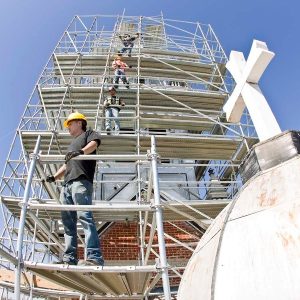
In construction, scaffolding plays a vital role. It provides the necessary support and access while a structure is being built. Yet it is never intended to remain. Once the building reaches a certain level of stability, the scaffolding is removed because it has fulfilled its purpose.
A similar pattern often unfolds in ministry.
Some people serve for a season rather than a lifetime. They offer strategic support rather than ongoing presence. They help build what is needed for a particular phase but are not assigned to remain for what comes next.
This is not a reflection of lesser commitment. It is a reflection of different callings within the unfolding work of God.
Scaffolding in Revitalization Contexts
While this principle is often discussed in the context of church planting, it is just as evident, and sometimes even more pronounced, in seasons of revitalization.
Why? Because transition tends to draw a particular kind of person.
These individuals are often energized by new leadership, responsive to changing environments, and eager for opportunities where they can contribute quickly and meaningfully. They step in with readiness and purpose, and for a time, they are exactly what the church needs.
It can be helpful to think of them as “home missionaries.” They invest their time, offer their gifts, give generously, and bring a level of energy that can accelerate momentum in critical moments.
Their impact is often catalytic.
But their assignment may not be permanent.
Why Their Departure Hurts So Much
The pain is not simply that they leave; it is rooted in what they represented.
These were people you trusted and relied on, people you assumed would be part of the long-term future. When they step away, it can feel as though something foundational has shifted, or even been lost.
It is often at this point that many pastors make a critical mistake by trying to hold on.
A Word of Caution: Don’t Cling to Scaffolding
When scaffolding people begin to step away, emotions can run high, and the instinct is often to persuade, convince, negotiate, or even recast the vision in an effort to keep them. Yet this response is rarely wise. In many cases, trying to hold on to people whose season is ending creates more harm than good over time.
The construction metaphor is helpful here. If scaffolding remains in place after the structure is complete, what once provided support can quickly become obstructive, misaligned, and even dangerous.
The same can happen in ministry. When people stay beyond their season, they can unintentionally shift from being a source of strength to a source of tension. At times, this shows up as resistance, misalignment with direction, or even attempts to redirect the vision itself.
What once functioned as a gift can, over time, become a burden.
How to Recognize Scaffolding People
You often identify scaffolding people in hindsight, but there are common characteristics:
- They arrive already spiritually mature and ready to serve
- They have a long history of involvement in multiple churches
- They show loose denominational attachment
- They demonstrate above-average generosity or hospitality
- They speak frequently about the importance of belonging
That final characteristic is often the most revealing, especially when you listen carefully to how they describe their departure. Phrases like “I don’t feel important anymore” or “We’re looking for a place where we belong” are common.
These statements are not necessarily expressions of criticism. More often, they signal that their season of investment and alignment has come to a natural close.
A Better Way to Respond
When scaffolding people tell you they are leaving, your response carries weight, not only for them but for the overall health and culture of the church. How you handle this moment will shape how others understand both leadership and transition.
A more constructive approach begins with sincere gratitude. Take time to thank them for their friendship, their service, and the specific ways they contributed to the mission of the church. Naming what they brought brings clarity and honour to their role.
Where appropriate, it can also be helpful to affirm their contribution publicly. This reinforces a culture of appreciation and helps the congregation interpret their departure in a healthy way, framing it as a transition rather than a loss or abandonment.
Finally, release them with grace. Resist the urge to hold on. Instead, bless them, commission them, and trust that God is already at work in what comes next for them. At the same time, trust that God will continue to provide what your church needs for the season ahead.
Reframing the Narrative
Not everyone who comes is meant to remain, and not everyone who leaves should be understood as a loss.
Some are entrusted to you for a season of building, while others are called to help sustain what has been established.
Discernment in revitalization lies in recognizing the difference and responding accordingly.
Final Thought
If you find yourself in a season where key people are leaving, it does not necessarily mean something has gone wrong. It may be a sign that something is taking shape, that what was needed for a time has served its purpose.
In that sense, the scaffolding is coming down, and it is meant to.
What remains, and what God continues to build, was never intended to depend on it.
I am grateful to Rodney Harrison for first helping me see the importance of “scaffolding people.”