Why Every Church Revitalization Pastor Needs a Coach
 Mike Puddicombe
 You hear it in the business world all the time that high level leaders surround themselves with people who sharpen them and many effective CEOs have coaches. Church planters are encouraged to find a coach early. A number of pastors leading large churches rely on coaching relationships to stay focused and effective.
It is not just a leadership trend. It is a pattern.
In professional sports, the best athletes in the world still have coaches. These are people performing at an elite level, yet they submit themselves to someone who can see what they cannot. Someone who is close enough to observe but far enough removed to speak with clarity. Someone who is willing to name what needs attention and keep them locked in on what actually produces results.
Now consider churches in a revitalization process.
Few ministry assignments are more demanding since you are stepping into a setting where decline has already taken root, systems are tired, trust may be thin, emotions often sit close to the surface, and every decision feels weighty because the margin for error is small.
And yet many leaders step into that environment alone.
That should concern us because even under good conditions, turnaround efforts fail far more often than they succeed. The odds are not in your favour. So it is worth asking a better question: “What would change if turnaround pastors consistently had someone walking with them through the process?”
The hesitation is real, even if it is rarely spoken out loud.
Some leaders assume they already know what to do and in many cases, they are right. Training, experience, and instinct have already given them a strong sense of direction so the issue is not information. The challenge is following through when pressure builds and resistance begins to surface.
That gap between knowing and doing is where many revitalization efforts stall.
Part of the problem begins in how we are formed as pastors since many of us were trained (I know I was) to be the one with all the answers. The expectation, whether stated or implied, was that the pastor should be able to handle whatever comes and when we cannot, it feels like failure rather than reality.
That mindset does not hold up well in a revitalization setting.
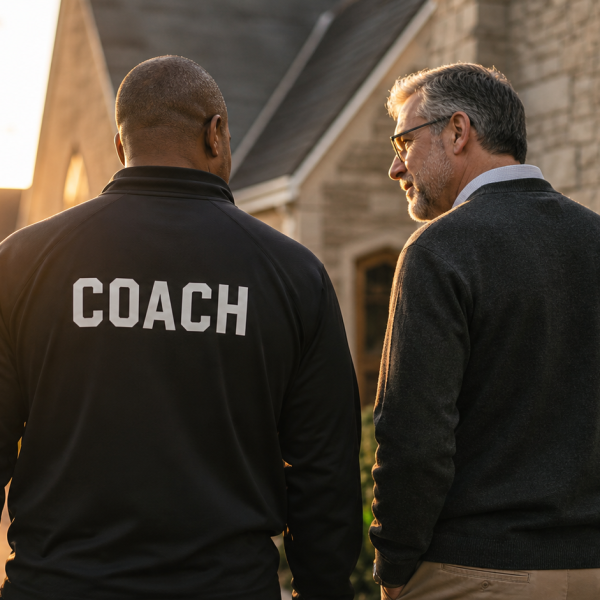
I remember when this began to shift for me. During a church plant, I started working with a coach (thanks Dale!) and it changed how I approached leadership. I no longer felt the need to carry everything on my own. I had someone who could challenge my thinking, help me stay focused, and bring me back to what mattered when I started to drift.
That is the real value of coaching.
A mentor often transfers knowledge. A coach helps you apply it with discipline. In a revitalization process, clarity fades quickly as competing voices demand attention. Conflict has a way of redirecting energy toward the urgent rather than the important. Without intentional focus, it becomes easy to spend your time in places that do not move the mission forward.
A coach keeps bringing you back.
They ask questions that force you to think clearly. They challenge assumptions that may be limiting your effectiveness. They help you separate signal from noise so you can lead with intention rather than reaction.
And there is another layer that often gets overlooked.
Church revitalization leadership carries weight that is hard to describe. Since you are dealing with people, history, and expectations all at once, there are not many spaces where you can speak freely about what you are experiencing without it being misunderstood or repeated.
A good coach creates that space.
It becomes a place where you can process honestly, sort through frustration, and regain perspective and that matters more than most leaders realize. Clarity is not just strategic; it is emotional.
And when progress feels slow, or invisible, that same voice reminds you that steady, faithful work still counts. That the absence of quick wins does not mean nothing is happening.
Church revitalizations are complex. They are also deeply personal. They will stretch you in ways few other assignments can.
Trying to navigate that alone is not a sign of strength. It is an unnecessary risk.
At this level, you do not need more content, you need consistent clarity. You need someone who will walk with you, keep you anchored, and help you stay aligned with what actually leads to renewal.
Finding the Right Coach
Finding the right coach matters.
Not every coach understands the weight and complexity of church revitalization because this is not a generic leadership challenge. It involves navigating decline, working within entrenched cultures, and leading change in environments where resistance is often strong and deeply rooted.
If you are looking for that kind of support, Mission Shift Church Consulting is built for this work.
Mission Shift focuses specifically on the realities of church revitalization. The coaching is grounded, practical, and shaped by real ministry contexts. You are not getting abstract leadership theory. You are getting guidance that takes into account the pressure, the people, and the pace of change required.
You still have to lead. You still have to make difficult decisions, but you do not have to figure it out on your own.